

The 4 Ps of Marketing: A Complete Guide to Product, Price, Place, and Promotion
Introduced by E. Jerome McCarthy, this marketing framework continues to help businesses develop effective marketing strategies. Whether you run a small business, an e-commerce store, or an established company, understanding the 4 Ps can help you reach the right audience and improve business growth.
What Are the 4 Ps of Marketing?
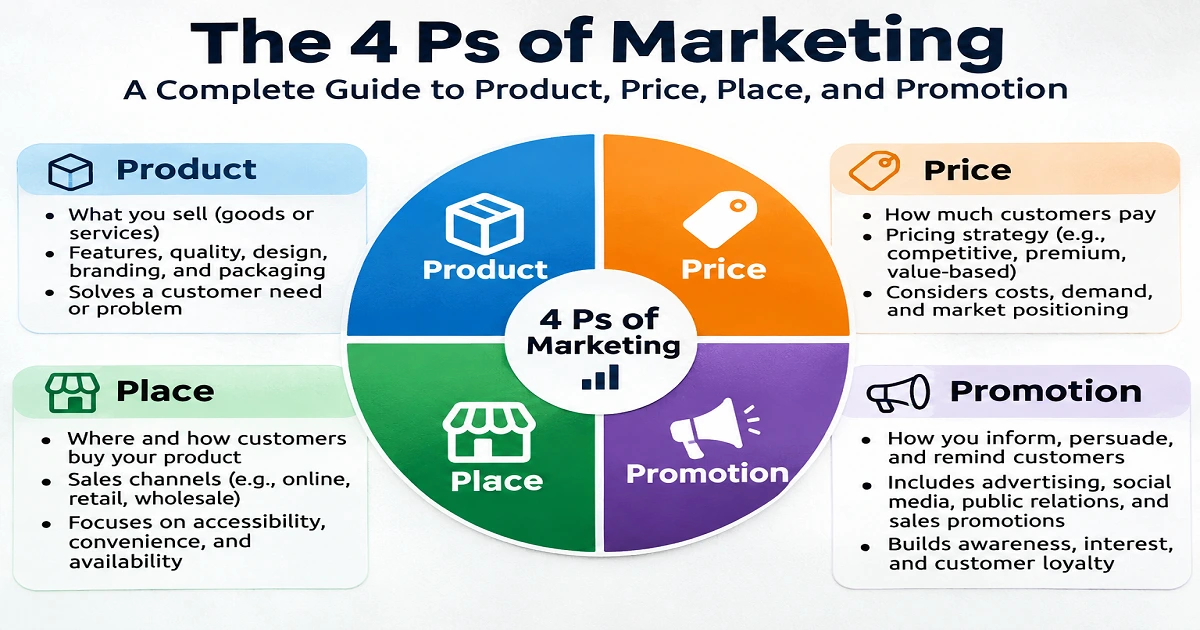
The 4 Ps of marketing represent four essential elements that influence how a product or service is presented and sold to customers.
1. Product – What Are You Offering?
Product refers to the goods or services a business provides to solve customer problems or fulfil their needs. A successful product strategy focuses on quality, features, design, packaging, customer experience, and its unique selling proposition (USP).
For example, a skincare brand may focus on natural ingredients and skin-friendly formulations to differentiate its products from competitors.
Businesses should understand their target audience and develop products that offer real value.
2. Price – How Much Should Customers Pay?
Price is the amount customers pay to purchase a product or service. A suitable pricing strategy considers production costs, competitor pricing, customer expectations, and perceived product value.
Common pricing strategies include:
Competitive Pricing: Setting prices according to market competition.
Penetration Pricing: Introducing a product at a lower price to attract customers.
Value-Based Pricing: Setting prices according to the value customers receive.
Psychological Pricing: Using prices such as ₹999 instead of ₹1,000.
The right pricing approach helps businesses remain competitive while maintaining profitability.
3. Place – Where Can Customers Find Your Product?
Place refers to the distribution channels through which customers access and purchase products or services.
Businesses can sell through physical stores, websites, e-commerce marketplaces, distributors, and online platforms. Modern businesses also use omnichannel marketing to provide customers with a consistent buying experience across different channels.
For example, an online clothing brand may sell through its website, marketplaces, and social media shopping channels to reach more customers.
4. Promotion – How Will Customers Know About Your Product?
Promotion includes all the activities businesses use to communicate with potential customers and encourage purchases.
Traditional advertising, search engine optimisation (SEO), content marketing, email campaigns, influencer marketing, and social media marketing are common promotional methods.
A well-planned digital marketing strategy helps businesses increase online visibility and connect with their target audience.
The Best Social Media Platform for Organic Reach in 2026
Social media has become an important part of modern promotional strategies. However, different platforms offer different opportunities for organic growth.
LinkedIn: Suitable for B2B marketing and professional audiences.
Instagram: Useful for visual content, Reels, and brand awareness.
YouTube: Effective for educational videos and long-term visibility.
Pinterest: Helpful for website traffic and visual content discovery.
Facebook: Useful for community engagement and local businesses.
Choosing the right platform depends on the target audience and business objectives. A consistent social media marketing strategy can help businesses improve organic reach without depending entirely on paid advertisements.
Example of the 4 Ps of Marketing in Practice
Consider a company selling organic skincare products:
| Marketing Element | Business Strategy |
|---|---|
| Product | Natural skincare products with quality ingredients |
| Price | Competitive pricing based on product value |
| Place | Company website, online marketplaces, and retail stores |
| Promotion | Social media, SEO, influencer marketing, and email campaigns |
This example shows how all four marketing elements work together to create a consistent business strategy.
What Are the 7 Ps of Marketing?
The 7 Ps of marketing extend the traditional marketing mix by adding three more elements: People, Process, and Physical Evidence.
These additional elements are particularly useful for service-based businesses because customer experience, service delivery, and trust play an important role in purchasing decisions.
Conclusion
The 4 Ps of Marketing provide a practical framework for planning and managing business activities. A valuable product, suitable pricing, convenient distribution, and effective promotion work together to create a strong market position.
Businesses that regularly review their marketing mix can better understand customer expectations, respond to market changes, and identify opportunities for growth. Combining traditional marketing principles with modern digital marketing strategies makes this framework relevant for businesses in 2026 and beyond.
Frequently Asked Questions
1. What are the 4 Ps of marketing?
The 4 Ps are Product, Price, Place, and Promotion. They form the basic marketing mix used to plan business and marketing strategies.
2. Why are the 4 Ps important in marketing?
They help businesses understand customer needs, set suitable prices, select distribution channels, and promote products effectively.
3. What is the difference between the 4 Ps and 7 Ps of marketing?
The 4 Ps focus on Product, Price, Place, and Promotion, while the 7 Ps additionally include People, Process, and Physical Evidence.
4. How do the 4 Ps apply to digital marketing?
Businesses use digital channels to promote products, manage online pricing, sell through websites and marketplaces, and understand customer preferences.
Comments
Log in with Facebook to join the conversation. We only use your name and profile photo.
No comments yet. Be the first to share your thoughts.