

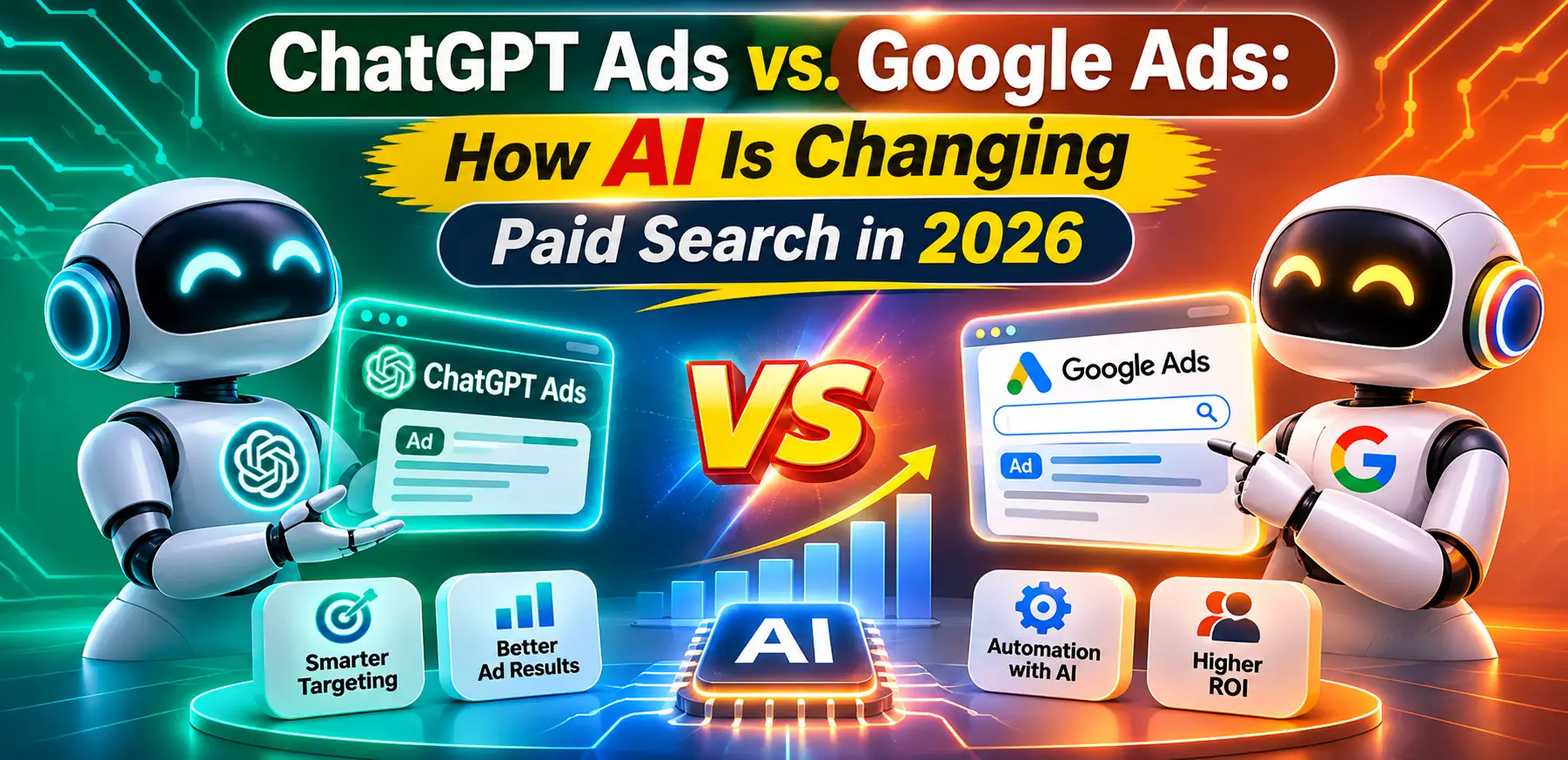
Google Ads vs. start exploring ChatGPT Ads
What Are ChatGPT Ads?
ChatGPT Ads are sponsored advertisements displayed separately from ChatGPT's organic responses. They help businesses introduce their products and services when users are exploring topics, asking questions, or comparing solutions.
For example, someone asking ChatGPT about digital marketing strategies for small businesses may encounter a relevant sponsored advertisement.
OpenAI expanded ChatGPT Ads to India in August 2026, with self-service advertising through Ads Manager becoming available on August 31, 2026.
These advertisements are designed around conversational context rather than relying exclusively on traditional keyword searches.
How Are Google Ads Changing with AI?
Google Ads has also evolved beyond traditional keyword-based advertising. AI now plays an important role in targeting, bidding, campaign optimisation, and ad placement.
Some important developments include:
Performance Max: Uses AI to reach potential customers across Google's advertising channels.
AI Max for Search: Helps Search campaigns discover additional relevant search opportunities.
AI Overviews Ads: Allows eligible advertisements to appear within Google's AI-generated search experiences.
AI Mode Ads: Creates advertising opportunities within Google's conversational search experience.
These developments show that AI is changing both traditional search advertising and online discovery.
ChatGPT Ads vs. Google Ads: Key Differences
Both platforms help businesses reach potential customers, but their advertising approaches are different.
Comparison | ChatGPT Ads | Google Ads |
|---|---|---|
Advertising platform | ChatGPT | Google ecosystem |
User behaviour | Conversational research | Searching and comparing |
Targeting | Conversation context and intent | Keywords, audiences and AI |
Ad placement | Below ChatGPT responses | Search, Shopping, YouTube and eligible AI experiences |
Campaign objectives | Views, clicks and conversions | Sales, leads, traffic and awareness |
Billing | CPM and CPC options | CPC, CPM and automated bidding |
Audience reach | Eligible ChatGPT users | Wider Google advertising network |
Platform maturity | New advertising channel | Established platform |
The main difference is that Google Ads captures existing search demand, whereas ChatGPT Ads offers opportunities to reach users during conversational research.
Which Platform Is Better for Different Businesses?
The right advertising platform depends on the business model, customer behaviour, budget, and marketing objectives.
1. Local Service Businesses
Businesses offering pest control, AC repair, plumbing, clinics, or website development should generally prioritise Google Search Ads.
Customers often search for specific services when they need immediate assistance. Location-based keywords can help businesses reach these potential customers.
2. Ecommerce Businesses
Ecommerce companies can focus on Google Shopping and Performance Max campaigns to promote products.
ChatGPT Ads can also be tested to reach customers researching products and comparing alternatives.
3. SaaS and Technology Companies
Software and technology businesses can explore both platforms. Google Ads can attract people searching for specific software solutions, while ChatGPT Ads can provide additional visibility during product research.
4. Education and B2B Companies
Educational institutions, training providers, and B2B companies can test both platforms because their customers often research multiple options before making a decision.
ChatGPT Ads vs. Google Ads: What Should Businesses Consider?
Before selecting an advertising platform, businesses should evaluate the following factors:
Advertising Budget: Start with a budget that supports meaningful testing without affecting profitable campaigns.
Target Audience: Understand where potential customers search for products and services.
Campaign Objectives: Decide whether the priority is brand awareness, website traffic, leads, or sales.
Conversion Tracking: Measure actual enquiries, purchases, and customer acquisition costs.
Landing Page Quality: Ensure that advertisements direct users to relevant pages with clear information and calls to action.
Businesses should not judge campaign performance only by impressions and clicks. Lead quality, conversions, and return on advertising spend are more meaningful indicators.
What Is the Future of AI-Powered Paid Advertising?
AI is changing how advertisements are delivered and how customers discover businesses.
Conversational advertising, automated bidding, contextual targeting, and AI-powered search experiences are becoming important parts of digital marketing.
As these technologies develop, businesses will need to understand customer intent and create relevant advertising experiences across different platforms.
The future of paid advertising will not depend on one platform alone. It will involve selecting the right channels according to customer behaviour and business goals.
Frequently Asked Questions (FAQs)
Are ChatGPT Ads available in India?
Yes. OpenAI expanded ChatGPT Ads to India in August 2026, with self-service Ads Manager access available from August 31, 2026.
What is the difference between ChatGPT Ads and Google Ads?
ChatGPT Ads appear within conversational AI experiences, while Google Ads reaches customers through Search, Shopping, YouTube, Display, and eligible AI-powered search placements.
Are ChatGPT Ads better than Google Ads?
Neither platform is universally better. Google Ads is useful for capturing active search demand, while ChatGPT Ads offers another opportunity to reach users during research and comparison.
Can businesses use ChatGPT Ads and Google Ads together?
Yes. Businesses can run campaigns on both platforms and compare their performance through conversion tracking, lead quality, and advertising costs.
How can businesses measure advertising performance?
Businesses should track clicks, conversions, cost per lead, customer acquisition cost, and return on ad spend to understand the effectiveness of their campaigns.
Conclusion
ChatGPT Ads and Google Ads represent two different opportunities in the changing digital advertising landscape.
Google Ads remains valuable for reaching customers actively searching for products and services, while ChatGPT Ads creates another way for businesses to connect with people during conversational research.
Rather than replacing one platform with another, businesses should understand their differences, test relevant opportunities, and invest according to measurable results.
The most effective advertising strategy in 2026 is not about choosing between traditional search and AI. It is about reaching the right customer at the right stage of their buying journey.
Comments
Log in with Facebook to join the conversation. We only use your name and profile photo.
No comments yet. Be the first to share your thoughts.
 .webp)


